



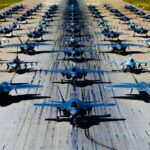

If you speak to friends or family in India these days, you might notice something interesting. Many genuinely feel that the United States is struggling in global conflicts, and that countries like Iran are giving it a tough fight or even winning. That perception is becoming quite common, and it mostly comes from what people are seeing regularly on television and social media.
When you constantly watch clips of attacks, strong responses, and dramatic headlines, it naturally creates a certain impression. The U.S. can start to look like it is reacting rather than leading, and over time, that feeling becomes stronger. From that point of view, it’s not surprising that many people begin to believe that America is losing its edge.
But when you step back and look at the bigger picture, the reality is very different. Global power today is not measured only by what appears in headlines. Modern warfare is not just about visible strikes or loud responses. It is about technology, intelligence systems, global reach, and long-term strategy. In all of these areas, the United States is still far ahead.
People who understand defense systems or follow military developments closely often point out that America has spent decades building capabilities that are not always visible to the public. Advanced weapons systems, surveillance networks, cyber capabilities, and the ability to operate across the world at any time are all part of that strength. This is the kind of power that does not show up in daily news clips, but it plays a much bigger role than what we see on screen.
So the question is not whether the U.S. is weak, but why it sometimes appears that way. The answer lies in how information is presented. News, by nature, focuses on what is immediate and dramatic. A single strike, a strong statement, or a tense moment gets highlighted again and again. Meanwhile, long-term positioning, strategic control, and quiet dominance rarely make headlines.
Over time, this creates a gap between perception and reality. When viewers repeatedly see one side of the story, it starts to feel like the complete picture. Add to that the speed of modern media, short videos, and selective clips, and it becomes even easier for a certain narrative to take hold.
If the United States were truly losing its global strength, the impact would be visible in much bigger ways. Alliances would begin to shift, global influence would weaken, and the balance of power would change. That is not what we are seeing. In fact, even its rivals understand the scale of American capability, which is why most situations remain controlled rather than escalating into something far more serious.
This is not just about one country or one conflict. It is a reminder of how easily perception can be shaped depending on what we are shown. Two people watching the same situation from different sources can come away with completely different conclusions.
The United States has not remained powerful by reacting loudly, but by staying strategically ahead in ways that are not always visible. What we see in the news is not always the full story—sometimes, it is just the most visible part of it.
Sunny Patil
Entrepreneur | U.S.–India Perspective

 English
 Hindi
Hindi Marathi