

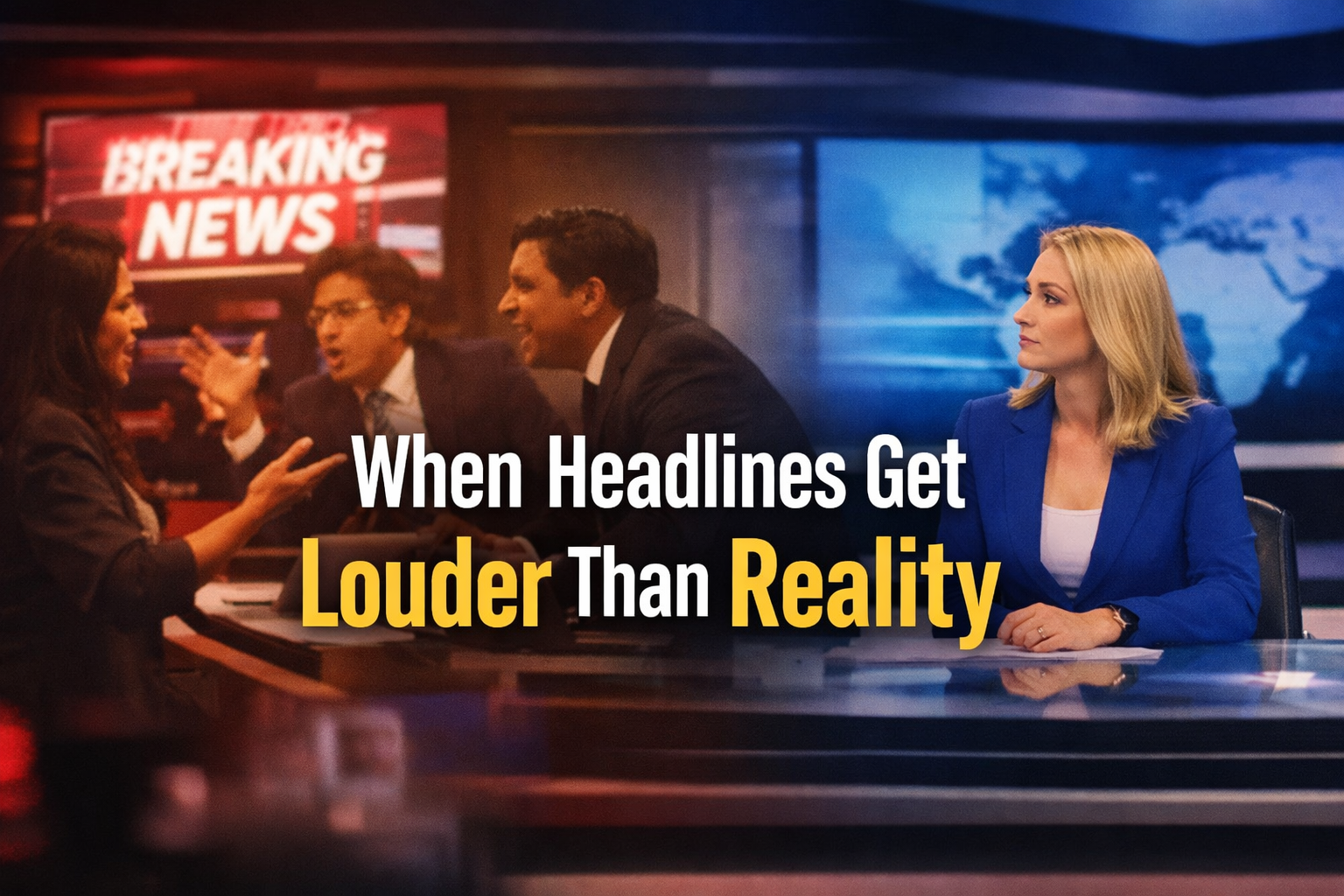
If you watched Indian television recently, you may have come away with a strong impression: that the world is on the edge of something serious, possibly even “out of control.”
But step back for a moment — is that really what’s happening, or is that how it’s being presented?
There’s a difference.
Global tensions are not new. Countries posture, leaders speak strongly, and militaries stay prepared — that’s been the nature of international politics for decades. What has changed is how quickly and dramatically these moments are turned into headlines.
Words like “war,” “danger,” “escalation” — they grab attention. And television, by design, competes for attention.
In India, news has evolved into something more energetic, sometimes even theatrical. Panels talk over each other, graphics flash urgency, and the tone is often charged. It keeps viewers engaged, no doubt. But it can also make situations feel bigger, faster, and closer than they actually are.
Compare that with most U.S. coverage. It’s not necessarily more accurate — but it is usually more measured. The same development might be discussed as a “rising concern” rather than an immediate crisis.
Neither approach is entirely right or wrong. They simply reflect different audiences and expectations.
The problem starts when viewers take tone as fact.
A loud headline doesn’t always mean a rapidly changing situation. Sometimes it just means the story is being told in a louder voice.
That doesn’t mean global tensions should be ignored. They should be followed, understood, and taken seriously. But they should also be seen in context — not through a single channel, and not through the most dramatic framing available.
For many Indians living abroad, this contrast becomes even more noticeable. Watching the same story from two different countries can feel like watching two different realities.
And that, perhaps, is the real takeaway.
Not that one side is right and the other is wrong — but that perspective shapes everything.
India2UsaDesk

 English
 Hindi
Hindi Marathi